Last updated 4 September 202610 min read
The effect comes on in seconds, peaks within the minute, and is entirely gone in five to ten minutes. That is short, it is normal, and no formula on the market changes it much. What really changes how it feels comes down to two things, and neither is a technique: the state of the bottle and the formula you pick. This page says which, with its sources.
Contents of this article
- The short answer, in numbers
- The timeline, minute by minute
- Why is the poppers effect so short?
- What makes the duration vary from one person to another?
- What changes in a bottle opened three weeks ago
- What the poppers base changes about duration
- How to boost the poppers effect: what works, and what does not
- Frequently asked questions
The short answer, in numbers
A few seconds to come on, under two minutes for most of the effect, five to ten minutes for everything to settle. The two French agencies do not give the same figure because they are not describing the same thing: the OFDT, the national drugs monitoring centre, describes the euphoric effect; the ANSM, the medicines agency, the whole episode.
| Milestone | Order of magnitude |
|---|---|
| First sensations | a few seconds to about fifteen seconds |
| Peak of the effect | under a minute |
| Euphoric effect | under two minutes |
| Whole episode | five to ten minutes |
| Extended comedown, next-day effect | None |
First sensations and overall duration: ANSM. Euphoric effect: OFDT. Neither the peak nor the absence of an extended comedown is quantified by any institution: these are converging orders of magnitude, not measurements. No published pharmacokinetic study settles it more precisely.
The timeline, minute by minute
- Inhaling
The bottle is open, vapour has formed above the liquid, you breathe it in through the nose. A few short inhalations are enough, keeping the bottle away from your nose: it is the liquid that irritates skin and lips, not the vapour. There is no point pushing it or drawing it out, the effect is not won that way.
- The first seconds
The sensation arrives almost at once: warmth rising to the face, a faster heartbeat, a full-headed feeling. It is also the moment when blood pressure drops, so the moment you may feel light-headed. Get comfortable, sitting or lying down, so you can enjoy it without risking a fall.
- The first minute
This is the peak, and it is brief. Past it the intensity falls away fast: the OFDT describes a euphoric effect lasting under two minutes. According to customer feedback and manufacturers, some formulas come on more gradually and feel slightly longer, though no study has ever measured it.
- The minutes after
Everything settles back. In some people only, a headache may appear. It is a known and catalogued effect, not a serious one, and its immediate form clears within the hour. No source describes an extended comedown or a next-day hangover.
Why is the poppers effect so short?
Because the body closes the door as fast as it opened it. The nitrite releases nitric oxide, blood vessels relax, blood pressure dips for a moment; as soon as you stop inhaling, the body clears that gas and everything returns to normal. It is the same family of mechanisms cardiology has used for over a century, and it is what makes the effect as brief as it is fast.
This is also what explains the one truly vital prohibition around the product. Poppers makes blood pressure drop for a moment, and the body brings it back up on its own. Erectile-dysfunction drugs prevent exactly that return to normal: it is how they work. Taken together, blood pressure goes down and does not come back up. That is what causes the collapse, and that is why the combination is banned.
What makes the duration vary from one person to another?
Fewer things than you are told. The only factor every source mentions is “individual sensitivity”, and none of them quantifies it: there is no benchmark by weight, by build or by sex, not even among sellers. What genuinely plays a part comes down to a few points.
- Habit. Tolerance can build with repeated use: Drogues Info Service, the French public drug-information service, describes it qualitatively, with no study measuring how fast.
- The first time. It does not last longer, but it makes more of an impression, because you do not yet know what you are meant to feel: see what happens the first time.
- Alcohol. It makes nothing last longer. What it does do, according to Drogues Info Service, is make headaches, dizziness and fainting more likely. Be careful with any combination, and always in moderation.
- Room temperature. The warmer it is, the more vapour sits above the liquid. That is not a study, it is physics: a bottle is still a liquid that evaporates.
- The state of the bottle. The most underrated factor by far, and the most common one: the next section is devoted to it.
What changes in a bottle opened three weeks ago
A great deal: it is the first explanation for an effect that has vanished. Alkyl nitrites are chemically unstable, sensitive to light, heat and air, and a little product evaporates every time you open the bottle. A bottle that “does nothing any more” is not a bad bottle: it is a tired one.
Let us be honest about the numbers: the famous “three to six weeks after opening” has no independent source - no health body and no safety data sheet publishes a shelf life after opening. The only sign of degradation documented outside sales copy is a smell: an old nitrite can take on a vinegary or stale odour. The yellowing repeated everywhere is confirmed by nobody. And if the smell has turned, you do not inhale it.
The container matters too, and it is the one thing you can actually see. A bottle in tinted glass or aluminium shields the contents from light far better than clear glass, and nitrites are sensitive to it. A cap that screws all the way down, child-resistant or not, limits what evaporates between uses. With the same formula inside, two bottles do not age at the same rate.
And the little ball at the bottom of some bottles? It is a frequent question, and its absence worries people more often than its presence does. Not every bottle has one. The manufacturers who fit one present it as an absorbent ball, meant to capture residual moisture and keep the product stable for longer. A bottle that has one is therefore perfectly normal, and so is a bottle that does not. If one is missing when the product page says otherwise, tell us: that one is on us.
The four possible causes are reviewed in what to do when your bottle does nothing, and storage in how long a bottle keeps.
What the poppers base changes about duration
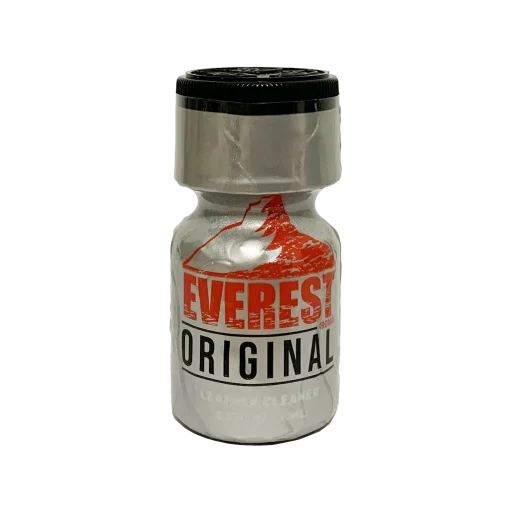
Only one thing is measurable: volatility, meaning how readily the liquid turns into vapour. It follows the length of the carbon chain: isopropyl is the most volatile on the market, amyl and pentyl markedly less so, hexyl less still. A highly volatile base saturates the air above the liquid faster: a sharper onset, and an opened bottle that runs out sooner. A less volatile base diffuses more slowly and holds up better once opened: typically pentyl-based bottles, such as the Everest Original or the Rise Up.
Ranking the bases by strength, on the other hand, rests on no official rule: no authority standardises the “mild / strong / extreme” scales. Ours is built on three things, and we would rather say so than present it as a measurement: the formula in the bottle, what the laboratory that makes it states, and what our customers tell us. We go into what the chemical base changes about duration, and what it does not, in a separate page.
How to boost the poppers effect: what works, and what does not
Let us start with what genuinely works, because the honest answer comes down to three points and none of them costs money: a recent, well-stored bottle, the right base for what you are after, and breathing normally between inhalations. Keeping two or three formulas to hand and switching now and then also helps you not get used to a single one.
Now for what does not work, whatever you may read elsewhere. None of the points below makes the effect last longer, and we would rather say so than sell you a method.
- Shaking the bottle. The liquid is homogeneous: there is nothing to put back into suspension. It is a ritual, not a technique.
- Overdoing the inhalations. It does not make the effect last longer, it stacks up the downsides: headache, dizziness, risk of falling. A little, spaced out, remains the right way.
- Adding alcohol. No extra duration, but a documented risk of feeling faint.
- Looking for a “long-lasting” poppers. There is no such thing: what the formula shifts is the shape of the onset, not the brief nature of the effect. Two or three different bottles beat a promise of duration that nobody keeps.
Which leaves the real question: if the effect is that brief, which formula should you pick? That is where the onset, the smell and the bottle size come in.
Which formula for what you are after?
Six questions, two minutes: the formula, size and strength that match how you use it, without reading seventy product pages.
Find my poppersFrequently asked questions
How long does the effect last? Seconds, an hour?
A few seconds to come on, under two minutes for the euphoric effect according to the OFDT, and five to ten minutes for the whole episode according to the ANSM. Never an hour: no formula on the market changes that order of magnitude.
Why was my bottle very strong when I opened it and does nothing a week later?
Because an alkyl nitrite is unstable and highly volatile: it degrades in light, in heat and in contact with air, and a little evaporates every time you open it. Closing it straight away and keeping it cool and out of the light slows this down. If the smell has turned vinegary, the bottle is at the end of its life: do not inhale it.
Can a poppers have a long-lasting effect?
No, and be wary of pages that promise one. The mechanism relies on nitric oxide, whose action stops as soon as the supply does. What varies from one base to another is the onset and the way vapour forms, not the duration, which stays in the order of a minute.
How long before I can drive?
There is no regulatory threshold and no roadside test specific to poppers, so no official figure exists. The sensible advice is simple: dizziness and a drop in blood pressure are among the effects, so wait until you are completely back to normal before taking the wheel. We go into it in our page on driving, police checks and work.
Our sources
- OFDT (French drugs monitoring centre): Poppers, a review of current knowledge (speed of onset, duration of the euphoric effect)
- ANSM (French medicines agency): information note of 7 October 2014 on the risks of poppers use - “rapid onset euphoria (15 seconds) lasting 5 to 10 minutes”
- Drogues Info Service (Santé publique France): Poppers factsheet, tolerance and combination with alcohol
- Classification internationale des céphalées (ICHD-3): headache induced by a nitric oxide donor, code 8.1.1
- ANSM, base publique des médicaments (French public medicines database): sildenafil product characteristics, contraindication of nitric-oxide donors “such as amyl nitrite”
- Ignarro et coll. (1981): the nitric oxide / cyclic GMP mechanism, behind the 1998 Nobel Prize in Medicine
Vous hésitez ?
Six questions, et l’outil vous propose le flacon qui correspond à votre usage.
Trouver mon poppers