Last updated 12 September 202614 min read
Amyl nitrite is the original poppers formula, once sold in glass ampoules. Compared with propyl, it evaporates more slowly: the bottle releases its vapour more gradually, lasts better once opened, and its smell is stronger. On Poppers Discount, you will find it among our high intensities.
Contents of this article
- What are amyl poppers?
- Amyl or propyl poppers: what's the difference?
- What amyl feels like
- Who are amyl poppers for?
- Our amyl poppers, size by size
- Before you open the bottle: what you must never do
- Storing an amyl bottle properly
- Amyl, isoamyl, pentyl: reading the label
- The chemistry of amyl: why it evaporates slowly
- Why amyl is sold freely in Europe
- What amyl does in the body
- From an angina remedy to poppers
- Frequently asked questions
What are amyl poppers?
These are poppers whose active substance is amyl nitrite. It is also the oldest formula: the word "poppers" comes from it, from the days when it was sold in small glass ampoules that made a "pop" when broken. Today it comes in a resealable bottle, often with a safety cap.
In practice, amyl-based poppers can be recognised by three things: they evaporate more slowly than propyl ones, their smell is hard to miss, and they are found almost only in strong bottles. All our amyl poppers are gathered in one section. They are sold freely to adults in France as a room aroma: they are neither a medicine nor a product to be swallowed. The full legal picture is in our guide to the legal framework.
Amyl or propyl poppers: what's the difference?
In searches about amyl-based poppers, this is by far the most common question. In short: propyl is more volatile, amyl is slower and more pronounced. What really changes is how the bottle behaves, and the range it belongs to.
- Propyl: it evaporates fast, so an open bottle runs out sooner. With us, it comes in “Moderate” or “Strong” intensity.
- Amyl: it evaporates more slowly, and an open bottle lasts better. With us, it falls under “Strong” and mostly “Extra-strong”.
To compare all four formulas side by side (propyl, amyl, pentyl, hexyl), see our formula comparison. If you are leaning towards propyl instead, our guide to propyl nitrite covers it in detail.
What amyl feels like
The effect of poppers arrives within seconds and lasts a few minutes. The two French public bodies that report on it do not give the same figure: the OFDT (the French monitoring centre for drugs and addictive behaviours) puts the main sensation at under two minutes, the ANSM (the French medicines agency) puts the whole episode at five to ten minutes. Everyone reacts differently, so the episode can run shorter or longer. For the detail, see how long the effect lasts.
In practice, the rush builds over about fifteen seconds. The heart speeds up, a wave of warmth spreads across the face and upper body, the skin flushes, the muscles relax. In the head, it is a brief high: euphoria, lightness, disinhibition, and heightened sexual arousal. Then it fades. Dizziness, a headache, some sweating or nausea can come with it: these effects are common and usually short-lived, but they are a sign that it is time for a break rather than another inhalation straight away.
As for the smell, expect something strong. PubChem, the United States' database of chemical compounds, describes amyl nitrite's smell as “penetrating, fragrant, slightly fruity”. If this is your first bottle, that smell can be surprising: it is normal and says nothing about the quality of the product. A smell that turns vinegary, on the other hand, is a sign of a bottle that has gone off. See how to spot a bottle that has gone off and where the smell of poppers comes from.
How you use it matters more than the formula: distance, breathing, pauses between inhalations. All of this is explained step by step in our instructions for use.
Who are amyl poppers for?
More for someone who already knows poppers. In our catalogue, amyl bottles all fall under the high intensities, “Strong” and mostly “Extra-strong”. That is not a property of the molecule: it is simply how manufacturers have built their ranges. You can check this in one click with all our amyl poppers or the products rated “Extra-strong”.
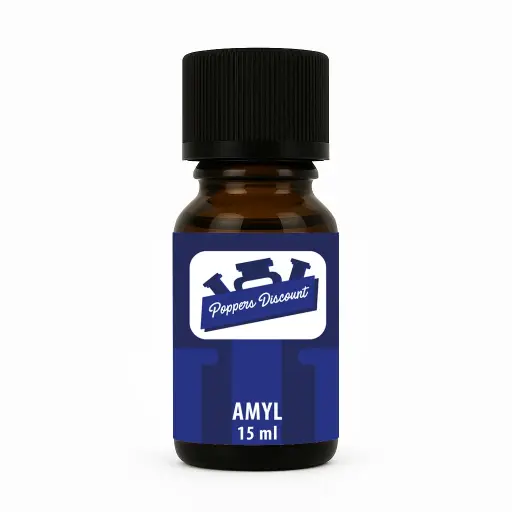
For a first time, it is better to start with a moderate intensity, or strong at most. With amyl, where we do not carry anything moderate, that means a product rated “Strong”, like our Poppers Discount Amyl, rather than an “Extra-strong” one. To see more choice, our “Moderate” products and our “Strong” products offer plenty of options, and this guide to your first time helps you avoid the usual mistakes. If instead you are after a bottle that lasts several weeks once opened, amyl has a real advantage, explained a little further down.
Our intensity ratings are not a matter of impression: they follow a written, dated scale that takes into account the formula, the concentration, the size and customer feedback. Here is how we rate every bottle.
Our amyl poppers, size by size
Amyl is one of the best-stocked sections of the shop: see all our amyl nitrite poppers. To help you find your way, here are four bottles that cover the main sizes.
| Product | Size | Intensity | Why this one |
|---|---|---|---|
| Poppers Discount Amyl | 15 ml | Strong | Our own amyl, named after its molecule |
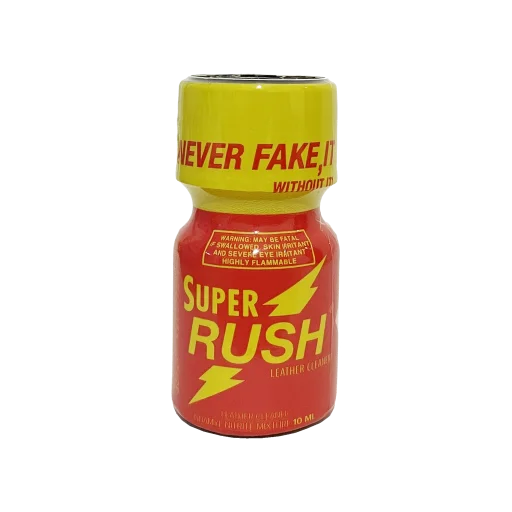
| Super Rush Original | 10 ml | Extra-strong | The small size, to try it without stocking up |
| Iron Fist | 24 ml | Extra-strong | An aluminium bottle, opaque to light |
| Everest Brutal | 30 ml | Extra-strong | The large size, for use spread out over time |
Intensity ratings follow our published scale. The current price and stock are shown on each product page. Tableau à faire défiler horizontalement.
The discount applies automatically in the cart: 5% from 3 poppers, 10% from 5, 20% from 10. Home delivery by La Poste is free in mainland France from the very first bottle, in a plain parcel. Since amyl keeps well once opened, a large size or several bottles make more sense than with propyl: how many to order.
Dangerous. Observe the precautions for use. Liquid and vapour are highly flammable; harmful by inhalation and if swallowed. Sold only to adults.
Not sure amyl is right for you?
Answer six questions about your poppers habits and what you are looking for: the tool shows you the bottles in our catalogue that match you, amyl or not.
Find my poppersBefore you open the bottle: what you must never do
Three more rules come from the molecule itself. It is highly flammable: never near a flame or a cigarette. It is never swallowed. And it irritates, even burns, skin and mucous membranes: you inhale it, you do not pour it (see what to do in case of a burn). For particular situations, heart, blood pressure, asthma or pregnancy, everything is covered in the contraindications.
If you feel unwell after use, stop there, close the bottle and sit or lie down. Open a window or go outside for fresh air: that is the first thing Drogues Info Service (the French public drug-information service) advises for dizziness or a headache. If it does not pass, if your chest tightens or your lips turn blue, call 15 or 112: the right steps while waiting for help. For a non-urgent question, Drogues Info Service answers anonymously and free of charge on 0 800 23 13 13.
Storing an amyl bottle properly
This is where amyl scores a point. Since it evaporates more slowly than propyl, an opened bottle runs out less quickly: it copes better with being opened and closed over several weeks. The good habits, though, apply to every formula: close it again right after use, and keep the bottle away from light and any source of heat.
Heat is public enemy number one, and a car is the classic trap: a US study measured 47°C inside a closed car after one hour, while it was only 22°C outside. So never leave a bottle in the glovebox, not even in spring. For more, see how long a bottle keeps and poppers and heat.
Amyl, isoamyl, pentyl: reading the label
On labels, three words describe very closely related products. Amyl nitrite and pentyl nitrite have exactly the same chemical formula: they are two different arrangements of the same atoms, what chemists call isomers. Isoamyl is the branched form, the one used in medicine. And commercially, “amyl nitrite” often refers to a mixture of the two.
Between amyl and pentyl, the gap is small: pentyl boils a few degrees higher, so it evaporates just slightly more slowly. Our guide to pentyl nitrite is devoted to it.
The chemistry of amyl: why it evaporates slowly
From here on, we go into detail, for those who want to understand why. None of what follows is necessary to choose a bottle well.
Amyl nitrite is an alkyl nitrite with five carbon atoms, formula C₅H₁₁NO₂, registered under CAS number 110-46-3 for the form sold in Europe. It is a yellow liquid, slightly lighter than water (density 0.875), which boils between 97 and 99°C according to its International Chemical Safety Card. That boiling point alone explains almost everything above.
The longer the carbon chain, the more the molecule has to be heated to boil, and the more slowly it evaporates at room temperature. Isopropyl nitrite, sold as propyl, boils at around 40°C; amyl at around 99°C; pentyl at around 104.5°C. Which is why an amyl bottle releases its vapour more gradually and copes better with being left open than propyl does.
Why amyl is sold freely in Europe
In Europe, a hazardous substance can be given an official classification, the same in every country: that is the role of the CLP Regulation. Amyl has one, which it shares with pentyl under a single entry (index 007-020-00-9): liquid and vapour highly flammable, harmful if swallowed, harmful by inhalation. No carcinogenic, mutagenic or reprotoxic label appears on it.
This is what sets it apart from isobutyl nitrite, classified as a presumed carcinogen (category 1B, index 007-017-00-2). Since 2005, that classification has closed off sale to the public across the whole European Union, pure or in a mixture: this is not an “anti-poppers” law singling out particular formulas, it is the rule that applies to every carcinogenic substance. If you do come across an isobutyl bottle, especially outside Europe, do not use it: on top of the risks common to all poppers, it is officially classified as able to cause cancer and liable to cause genetic defects. The rules and their consequences in France are covered in our guide to the legal framework.
What amyl does in the body
Amyl nitrite releases nitric oxide, a small molecule that relaxes smooth muscle, particularly in the walls of blood vessels. The vessels dilate, blood pressure drops slightly and the heart speeds up to compensate: that is where the rush of warmth and the flushed face come from. Nitric oxide works by raising, inside those muscles, a messenger molecule called cyclic GMP.
That is exactly where the danger lies with erectile-dysfunction drugs. Sildenafil and medicines in the same family stop that same cyclic GMP from being broken down. Taken together with a nitrite, the two effects add up instead of balancing out, and blood pressure can collapse. The official sildenafil product information, available in the French public medicines database, names amyl nitrite specifically among the products never to combine it with. Official product information, in France as in the United States, contraindicates the combination in any form: that is why we never recommend it, not even some time after taking the medicine.
The same dilation explains the headache many people feel after use: the International Classification of Headache Disorders gives it its own category, headache attributed to a nitric oxide donor. The other side effects are reviewed in headache and side effects.
From an angina remedy to poppers
Amyl nitrite was first synthesised in 1844 by the French chemist Antoine Jérôme Balard. In 1859, the British chemist Frederick Guthrie described what inhaling small doses produced. And in 1867, the Scottish physician Thomas Lauder Brunton reported in The Lancet that he used it to relieve attacks of angina pectoris.
At the time the product was sold in small glass ampoules, which were snapped to release the vapour. The sound of the glass breaking gave it its nickname: “poppers”. The rest of the story, up to today's bottles, is told in the history of poppers.
In the United States, amyl nitrite was sold over the counter to heart patients for a long time. Faced with recreational misuse, the US medicines agency put it back under prescription from 1 July 1969, a decision still written into the federal code. What we sell in France is nothing like a medicine: it is a room aroma, which treats nothing and replaces no treatment.
Frequently asked questions
Amyl or propyl poppers: which is stronger?
No authority ranks the formulas by strength, and no study compares them against each other. What is true is that with us most amyl bottles are rated “Extra-strong”, while propyl ones range from “Moderate” to “Strong”: that is a matter of range, not molecule. Our intensity scale explains how each bottle is rated.
Are amyl nitrite and pentyl nitrite the same thing?
Almost. They have the same chemical formula, with a different arrangement of atoms, and Europe classifies them under one single entry. Pentyl boils a few degrees higher, around 104.5°C against 99°C for amyl, so it evaporates just slightly more slowly. No study has compared their effects.
Why do amyl poppers smell so strong?
Because the molecule evaporates at room temperature and its smell is naturally strong: the PubChem database describes it as penetrating, fragrant and slightly fruity. No poppers formula is odourless. A vinegary smell, on the other hand, is not normal: it is a sign that the bottle has gone off.
Was amyl nitrite really a medicine?
Yes. Since Thomas Lauder Brunton's work, published in 1867, it has been used to relieve attacks of angina pectoris. In the United States, it has remained a prescription medicine since 1969. The poppers sold in France, though, are a room aroma: they treat nothing and replace no treatment.
Do amyl poppers keep longer?
Once opened, yes, in principle: it evaporates more slowly than propyl, so an opened bottle runs out less quickly. That does not remove the need for good habits: close it again right after use, keep the bottle cool and in the dark, and never leave it in a car in the sun.
Our sources
- OFDT (the French monitoring centre for drugs and addictive behaviours): Poppers, a review of current knowledge (definition, duration of the main sensation)
- ANSM (the French medicines agency): information notice of 7 October 2014 on the risks linked to poppers (duration of the episode)
- ANSM, base publique des médicaments (the French public medicines database): summary of sildenafil's product characteristics, contraindication of nitric oxide donors including amyl nitrite
- FDA: US product information for Viagra (sildenafil), contraindication of nitrates “in any form”
- ECHA: “amyl nitrite, mixed isomers” entry, harmonised classification index 007-020-00-9, shared by amyl and pentyl
- CLP Regulation (EC No. 1272/2008), Annex VI: entries 007-020-00-9 (amyl and pentyl) and 007-017-00-2 (isobutyl, Carc. 1B)
- Istituto Superiore di Sanità (the Italian national institute of health), February 2008 bulletin: isobutyl nitrite banned from sale to the public across the EU since 2005 (Directive 76/769/EEC)
- International Chemical Safety Card ICSC 1012 (ILO, WHO): isoamyl nitrite, yellow liquid, boiling point 97 to 99°C, density 0.875
- NIST Chemistry WebBook: boiling points of isopropyl nitrite, isoamyl nitrite and pentyl nitrite
- PubChem (the United States National Library of Medicine): isoamyl nitrite (odour description) and isobutyl nitrite (classified “may cause cancer” and “suspected of causing genetic defects”)
- Pediatrics, 2005: McLaren et al., temperature rise inside a closed car in the sun (47°C in one hour for 22°C outside)
- International Classification of Headache Disorders (ICHD-3), code 8.1.1: headache attributed to a nitric oxide donor
- Wellcome Collection: T. Lauder Brunton, “On the use of nitrite of amyl in angina pectoris”, The Lancet, 1867
- Wikipedia: amyl nitrite (synthesis by Balard in 1844, Guthrie's observations in 1859) and poppers (origin of the word)
- United States Code of Federal Regulations, 21 CFR 250.100: inhalant amyl nitrite put back under prescription from 1 July 1969
- Drogues Info Service (Santé publique France, the French national public health agency): Poppers factsheet, precautions and combinations to avoid; 0 800 23 13 13
- Service-public.fr (the French public administration portal): emergency numbers 15 and 112, poison-control centres
Vous hésitez ?
Six questions, et l’outil vous propose le flacon qui correspond à votre usage.
Trouver mon poppers